Easy Words - Word Puzzle Games
- 4.8
- Rating
- 1.00M
- Installs
- Free
- Price

 Analysis by App-foxy
I went into Easy Words expecting a familiar letter game, but its appeal became clearer after several rounds: it turns a small set of letters into a quick contest that rewards both vocabulary and timing. Developed by Easybrain, this free word game is built around forming words and trying to beat an opponent, yet it feels more like a compact mental workout than a long-form puzzle adventure. My overall view is positive, with one important qualification: it works best when you want short, focused sessions rather than a deep word-game system that you can study for weeks.
The game sits in the word category, and that description is accurate without telling the whole story. You are not simply solving a crossword at your own pace. The competitive framing gives each choice more pressure, because an ordinary word can be useful if it arrives quickly, while a clever word may be less valuable if you spend too long searching for it. That balance between vocabulary and decision-making is what kept me coming back.
How the letter battles feel in everyday play
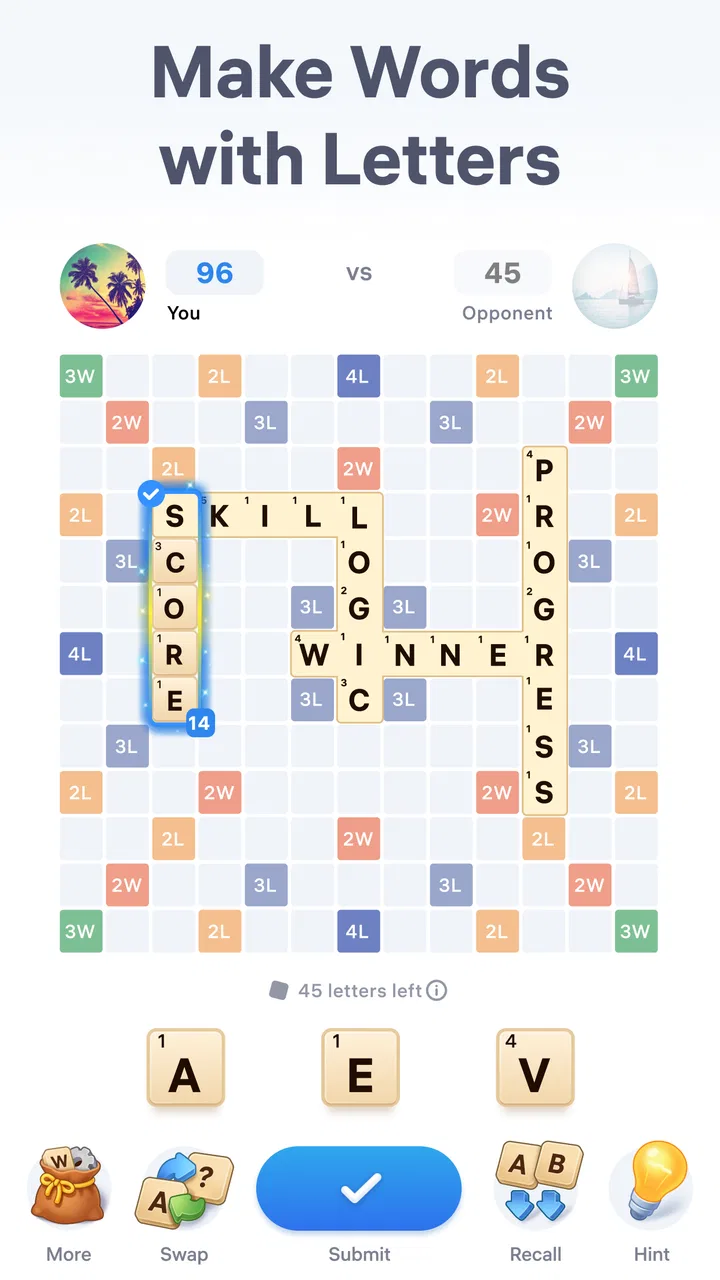
The basic idea is easy to understand. Letters are presented, and I use them to build valid words while working toward an advantage over the opposing player. The first few rounds are especially approachable because there is no need to learn a complicated control scheme. I could start playing almost immediately, which makes the game suitable for a spare moment rather than a dedicated evening.
You May Also Like

 Blood Strike: 2.5 Anniversary
Blood Strike’s Loadouts Turn Every Drop Into a Tactical Gamble
A close look at Blood Strike’s custom loadouts: how fast access to signature weapons reshapes its battle royale rhythm, rewards preparation, and narrows the gap between fights.

 Pandora - Music & Podcasts
Pandora’s Music Is Easy to Start, but Harder to Recover
Pandora’s strength is its low-effort path from a seed to a station. Its weak spot is how much confidence it asks you to place in connection, setup, and quiet recovery.

 8 Ball Pool
 Is Built on Rivalries, Rematches, and Routine
A close look at the rivalries, rematches, shared routines, and unanswered safety questions that turn a quick pool match into a persistent mobile community.

 Samsung Music
’s Quiet Strength Is Playing What You Already Own
Its reach comes less from spectacle than from dependable access to a personal library. That simplicity is both the app’s strongest retention engine and its ceiling.

 AccuWeather: Weather Radar
AccuWeather Review: A Quick, Clear Forecast for Everyday Decisions
For everyday plans, the best forecast is the one you can understand quickly. AccuWeather makes rain timing, radar, and local conditions easy to act on, with a few trade-offs.

 Hill Climb Racing
Why Hill Climb Racing Still Turns Crashes Into One More Run
A tiny car, a bumpy hill and one more upgrade: Hill Climb Racing keeps resurfacing because its simple chaos makes every near-miss feel personal.
More From Our News Desk



What makes the format more interesting than a standard anagram exercise is the opponent. Even when the board looks simple, I am making two decisions at once: which word I can see and whether it is worth using now. A short, obvious word can be the sensible move when I want to keep momentum. On the other hand, holding back while looking for a stronger combination can pay off, but it also creates the risk of wasting time or missing an opportunity.
That tension gives the game its strongest evidence of quality. The letters themselves are not enough to create a good round; the contest changes how I read them. I found myself scanning for common endings, checking whether a plural or a familiar verb form was available, and then abandoning a promising idea when it took too long to assemble. Those small choices make the experience feel active rather than automatic.
For a realistic everyday use case, I would open it while waiting for a coffee, sitting on public transport, or taking a short break between tasks. A round can be approached as a quick reset for the mind: it demands attention, but not the kind of uninterrupted concentration needed by a long strategy game. I also found it more satisfying than endlessly scrolling through social feeds because each session gives me a clear problem to solve and a definite result.
Why the competitive format matters
Playing against an opponent changes the value of familiar vocabulary. In a solo puzzle, I can explore every possibility without feeling rushed. Here, I have to trust my first useful idea more often. That makes the game a good exercise in flexible thinking, especially for players who know plenty of words but tend to overthink their choices.
There is also a subtle difference between recognizing a word and producing it under pressure. I sometimes knew that a combination was possible but could not find it quickly enough. In other rounds, a simple word appeared immediately and proved more useful than a more ambitious search. This is where the game feels less like a dictionary test and more like a reaction-and-planning challenge.
One practical tip is to avoid treating every round as a hunt for the longest word. I got better results when I first collected the obvious options mentally, then checked whether a less impressive word could be played immediately. Another useful habit is to look at the letters as groups rather than individually. Common prefixes, endings, and familiar two-letter links can reveal possibilities faster than trying to rearrange the entire set from scratch.
These habits are not presented as a formal tutorial, but they make a real difference to the experience. The game rewards players who develop a personal scanning routine. I started by looking for the most visible word, then moved to endings and alternate forms, and finally considered whether delaying a move was worth the risk. That workflow made later sessions feel more deliberate without turning them into homework.
Accessibility, cost, and the practical setup
Easy Words is free to download, which lowers the barrier for anyone curious about the format. It is available for devices running Android 8.0 or later, so people using older hardware may need to check compatibility before planning to play. The game is marked for Teen audiences, an important detail for families deciding whether it fits a younger player's device.
The current version is 2.12.0, and the game has passed the early-adoption stage: it has more than a million installs, with an average rating of 4.6 from about ninety-eight thousand ratings and roughly two thousand three hundred written reviews. Those figures suggest that the core idea has found a substantial audience, although they do not remove the need to decide whether competitive word play matches your own preferences.
There are in-app purchases priced at $14.99 per item. I would treat that as a reason to pay attention during setup and play, particularly if the device is shared with a child or another family member. The free entry point is useful for testing the game, but anyone who dislikes purchase prompts or prefers a completely self-contained experience should approach it with that trade-off in mind.
The fact that the game is free also makes it easier to use as a casual social challenge. I can recommend it to a friend without asking them to buy a full game first. That is a meaningful advantage over paid word titles when the goal is simply to compare a few rounds and see who adapts faster.
The weakness that becomes clearer over time
The same focused design that makes Easy Words approachable can become limiting for players who want a large, layered word-game experience. The central activity remains the attraction, so anyone expecting extensive story content, elaborate exploration, or a broad collection of unrelated puzzle modes may find it narrow. I did not see that as a flaw in short sessions, but it matters if you want one game to provide weeks of varied progression.
Another limitation is that vocabulary confidence can strongly shape the experience. Players who read widely or already enjoy word puzzles may have an immediate advantage, while people with a smaller active vocabulary may feel that they are losing because they cannot see enough possibilities quickly. The game can encourage learning through repetition, but it is still primarily a contest, not a structured language course.
That distinction is important when choosing between this and a traditional crossword or an untimed anagram app. A crossword is usually better when I want clues, context, and a slower sense of discovery. A solo anagram game is a better fit when I want to experiment freely without an opponent affecting my choices. Easy Words is stronger when I want urgency and direct competition, but weaker when relaxation and depth are the main goals.
I also think the competitive format can make a poor match for players who dislike losing in short bursts. A defeat may come down to one missed word or one delayed decision, which is exciting when I am in the mood for a challenge but irritating when I want a calm break. The game is at its best when I accept that some rounds will expose gaps in my vocabulary or timing rather than treating every result as a judgment of skill.
Who should install it, and who should skip it
I would recommend Easy Words to people who enjoy word puzzles but want more pressure than a standard solo board provides. It suits players who like quick decisions, familiar vocabulary, and the satisfaction of finding a useful word before an opponent does. It is also a good choice for someone looking for a light mental activity that can fit into short gaps in the day.
It may appeal to families and friends who want an easy game to discuss or compare, although the Teen content rating should guide household decisions. The simple premise means I would not need to explain a complicated ruleset before inviting someone to try it. A player can understand the objective quickly, then improve naturally by noticing patterns and managing time more confidently.
I would be more cautious about recommending it to someone who wants a quiet, completely untimed puzzle. That player would probably be happier with a crossword app or a relaxed anagram title. I would also suggest skipping it if in-app purchases are a firm deal-breaker, since the free download does not mean every part of the experience is necessarily free of purchase-related friction.
For language learners, the game can be useful as a vocabulary prompt, but I would not use it as the main learning tool. It encourages recall and quick word formation, yet the competitive pace leaves little room to explain why a word is valid or how it is used. A dictionary or dedicated language app would provide better instruction, while this game could serve as a short practice activity after studying.
Small tactics that make rounds more enjoyable
My most useful adjustment was to separate recognition from action. Instead of immediately playing the first word I noticed, I quickly checked whether the remaining letters suggested a common ending or a related form. This took only a moment, but it reduced the number of rounds where I used an acceptable word and then immediately spotted a better opportunity.
I also learned not to chase obscure vocabulary simply because it might be valuable. If a word is difficult to recall or assemble, the search can cost more than it gains. A reliable everyday word is often the better choice when the opponent's pressure is high. That trade-off is one of the game's more interesting lessons: knowledge helps, but judgment determines when to use it.
A third tip is to treat losses as information rather than as reasons to repeat the same approach. When I missed a round, I tried to identify whether the problem was vocabulary, slow scanning, or hesitation. If the issue was scanning, I practiced looking for endings first. If it was hesitation, I committed to the strongest obvious option sooner. This makes improvement feel concrete even though the game stays simple.
Players who want a fairer personal challenge can also set their own limits, such as avoiding repeated searches for the same familiar patterns or focusing on speed in one session and word variety in another. These self-imposed goals add freshness without pretending that the game needs a complicated progression system. They are especially useful once the basic format becomes familiar.
My final recommendation
Easy Words succeeds because it keeps its central idea clear while adding enough competitive pressure to make ordinary letters feel meaningful. I enjoyed it most in short sessions, when I wanted something more engaging than passive entertainment but less demanding than a full strategy game. The strongest part is the decision-making: choosing between a safe word now and a potentially better word later gives the rounds their character.
Its limitations are equally clear. The experience may feel narrow to players seeking many modes, a story, or a long progression system, and the competitive pace is not ideal for everyone. The presence of in-app purchases also means that free access should be viewed as an invitation to try the game, not as a guarantee that every optional element will remain outside spending.
Still, I think the balance is convincing for the right audience. Easybrain has made a word game that is quick to understand, easy to fit into daily routines, and capable of rewarding both vocabulary and composure. If you want a compact word contest rather than a traditional crossword or a completely relaxed anagram puzzle, this is worth trying. I would install it for quick challenges, recommend it to friends who enjoy wordplay, and choose a different app only when I wanted slower solving, more instruction, or a broader range of activities.
FAQs for Easy Words - Word Puzzle Games
01What is Easy Words - Word Puzzle Games?
Easy Words - Word Puzzle Games is a fun and engaging mobile application designed to challenge your vocabulary skills. The app offers a variety of word puzzles where players must connect letters to form words. It's available on both Android and iOS platforms, making it accessible to a wide range of users.
02How do I play Easy Words - Word Puzzle Games?
Playing Easy Words - Word Puzzle Games is simple and intuitive. Players are presented with a grid of letters and must swipe to connect them in the correct order to form words. The puzzles range from easy to challenging, catering to both beginners and seasoned word game enthusiasts.
03Are there any in-app purchases in Easy Words - Word Puzzle Games?
Yes, Easy Words - Word Puzzle Games offers in-app purchases that enhance the gaming experience. Players can buy hints or additional puzzle packs to unlock more content. While the game is free to download, these purchases can help progress through tougher levels more smoothly.
04Is Easy Words - Word Puzzle Games suitable for all ages?
Absolutely! Easy Words - Word Puzzle Games is designed to be family-friendly and suitable for players of all ages. The game’s difficulty levels adjust to provide a challenging yet enjoyable experience for children, teenagers, and adults alike, making it a perfect choice for family entertainment.
05Does Easy Words - Word Puzzle Games require an internet connection?
No, Easy Words - Word Puzzle Games can be played offline. This feature allows users to enjoy the game anytime and anywhere without needing an internet connection, making it ideal for on-the-go entertainment or areas with limited connectivity.
Pros
- Engages users with diverse word puzzles.
- Encourages vocabulary expansion.
- Suitable for all age groups.
- Offline mode for uninterrupted play.
- User-friendly interface.
Cons
- Occasional ads may disrupt gameplay.
- Limited hints for challenging puzzles.
- In-app purchases for extra features.
- No multiplayer options available.
- Requires frequent updates for new content.

Easy Words - Word Puzzle Games
Gallery